Wondering which lab skills employers actually look for? Start with careful technique, clear records, safety habits and basic data sense. Everything else in a life science career builds on those four.
| Item | Value |
|---|---|
| Nonclinical laboratory study (21 CFR Part 58) | In vivo or in vitro experiments in which test articles are studied prospectively in test systems under laboratory conditions to determine their safety |
| Study director | The individual responsible for the overall conduct of a nonclinical laboratory study |
| Raw data | Laboratory worksheets, records, memoranda, notes, or exact copies of original observations |
| Quality assurance unit | Any person or organizational element, except the study director, designated to perform quality assurance duties |
| OSHA Laboratory standard (29 CFR 1910.1450) | Sets mandatory requirements for a Chemical Hygiene Plan |
| Chemical Hygiene Plan staffing | Includes assignment of a Chemical Hygiene Officer |
These definitions come from the eCFR text of 21 CFR Part 58 and the OSHA Chemical Hygiene Plan fact sheet. Rules can change, so check the source before you rely on them.
What counts as a lab skill?
A lab skill is any repeatable ability that lets you produce trustworthy results at the bench and prove how you got them. It covers hands-on technique, but also documentation, safety, troubleshooting and communication. Hiring managers tend to read all of these as one signal: can this person be left with an experiment?
It helps to sort the skills into groups, because different roles weight them differently:
- Technical skills: pipetting, solution preparation, PCR, cell culture, microscopy, chromatography and similar methods.
- Quality skills: record keeping, following written procedures, and spotting deviations.
- Safety skills: chemical, biological and equipment hygiene, and knowing what to do when something goes wrong.
- Analytical skills: handling data, choosing sensible controls and statistics, and judging whether a result is believable.
- Communication skills: writing methods clearly, presenting results and handing work over to colleagues.
You do not need to master every item before your first job. Most people begin with a handful of methods and widen their range as projects demand it. What employers notice early is how carefully you work, not how many acronyms you can list.
If you are still deciding where these skills could take you, the overview of biotech careers shows how bench work connects to roles in quality, development and manufacturing. The wider biotech industry picture explains why those roles value different mixes of skills.
Core bench techniques to learn first
Nearly every wet lab relies on a small set of foundations. Learning these foundations early can reduce confusing results caused by technique errors. They can produce noisy or biased data that analysis may not resolve.
Accurate liquid handling
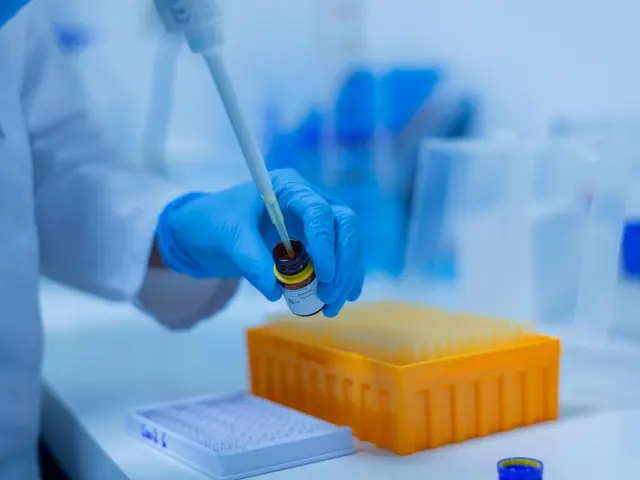
Measuring small volumes correctly is the quiet foundation of almost every assay. Habits such as pre-wetting tips, holding the pipette vertically and keeping a steady rhythm affect precision more than most beginners expect. Our guide to pipetting techniques walks through the habits that matter and the mistakes that cost the most.
Practise with water on a balance if your lab allows it. Repeated dispensing shows you your own drift, and it costs nothing but a little time.
Making solutions and keeping things clean
Preparing buffers, media and reagents sounds simple, yet it is where many silent errors begin. Check the calculation twice, label every container with contents, date and your initials, and record lot numbers. A mislabelled tube can invalidate a week of work.
Aseptic technique deserves its own mention. Working near a flame or in a biosafety cabinet, wiping surfaces and keeping lids on are habits you build through repetition, not reading.
Amplifying and detecting DNA
The polymerase chain reaction is a staple in research, diagnostics and process development. Learning to design primers, set up reactions without contamination and read a gel or readout gives you a transferable method. The essentials are covered in pcr basics, including why negative controls matter.
Growing cells reliably
Mammalian, microbial and insect cells all need consistent care, and cell work punishes inattention. Passaging on schedule, watching morphology and testing for contamination are routine tasks. For a structured introduction, see cell culture techniques.
Documentation: the skill that makes results count
An experiment you cannot reconstruct is, in practice, an experiment that did not happen. Good records let a colleague repeat your work, let a supervisor check it and let you remember what you did months later. Documentation complements technical skill by making work traceable.
Strong records usually share a few traits:
- Each entry is dated and signed or initialled at the time of the work.
- Materials, lot numbers, instrument settings and sample identifiers are written down.
- Deviations from the plan are noted honestly, not tidied away.
- Raw outputs such as images, traces and files are linked to the entry.
- Corrections are made with a single line and a note, never by erasing.
The regulations make the idea concrete. In the GLP rule, raw data covers laboratory worksheets, records, memoranda and notes that result from original observations and are needed to reconstruct and evaluate a study report, as the eCFR text of 21 CFR Part 58 defines it. The same section allows an exact copy or verified transcript to stand in for an original under set conditions.
Whether you use paper or an electronic system, the habits are the same. Our page on lab notebook best practices covers layout, timing and what to do when an entry goes wrong.
Safety and regulated-lab skills
Safety is not a separate topic from science. A lab that cannot protect its people cannot produce reliable work for long, and employers read your safety habits as a sign of overall discipline.
Chemical hygiene in everyday work
In the United States, OSHA’s Laboratory standard (29 CFR 1910.1450) sets out the mandatory requirements for a written Chemical Hygiene Plan. According to the OSHA fact sheet, the plan includes standard operating procedures for each activity involving hazardous chemicals. It also includes designating the personnel responsible, including a Chemical Hygiene Officer.
For you as a new scientist, that translates into practical habits:
- Read the safety data sheet before you use an unfamiliar chemical.
- Wear the protective equipment your procedure calls for, every time.
- Know where eyewash stations, showers and exits are located.
- Report spills, near misses and damaged equipment promptly.
- Ask your Chemical Hygiene Officer or supervisor when a procedure is unclear.
The same fact sheet notes that worker training covers the physical and health hazards of chemicals in the work area and the measures workers can take to protect themselves. Treat training sessions as working knowledge, not paperwork.
Working under good laboratory practice
Some labs generate safety data that regulators review. For those, the GLP rules shape daily life. The rule in 21 CFR Part 58 defines a nonclinical laboratory study as in vivo or in vitro experiments in which test articles are studied prospectively in test systems under laboratory conditions to determine their safety, per the eCFR.
Two roles stand out. The study director is the individual responsible for the overall conduct of a study, and the quality assurance unit is a person or group, other than the study director, designated to handle quality oversight. The separation is deliberate: the people checking the work are not the people running it. Our overview of good laboratory practice explains how this plays out for a bench scientist.
Manufacturing environments
If you move toward production of clinical or commercial material, the vocabulary shifts to batch records, deviations and change control. The mindset, though, is familiar: write down what you do, do what you wrote, and show your work. Our primer on gmp basics introduces that world for people coming from research.
Analysis and communication skills
Bench skills produce data, but data only matter once someone understands them. Modern experiments generate far more numbers than a person can eyeball, so basic analysis is part of the job for nearly every biologist.
Making sense of results
You do not need to become a statistician, but you should be able to do the following:
- Design experiments with appropriate controls and replicates.
- Choose a sensible plot instead of defaulting to a bar chart.
- Investigate outliers using controls, records and repeat measurements before attributing them to biological variation or technical error.
- Keep analysis scripts or spreadsheets traceable, so a colleague can repeat them.
A practical starting point is data analysis for biologists, which focuses on the questions bench scientists meet most often.
Writing and presenting clearly
Methods sections, standard operating procedures, lab meeting slides and emails all test the same skill: saying exactly what happened in plain language. Vague writing in a procedure leads to vague results in someone else’s hands. Practise by writing a method so precisely that a new colleague could follow it unaided, and see our guide on scientific writing skills for structure and habits.
How to build and show your lab skills
Deliberate practice and records of your progress can help you build skills. A plain plan works better than collecting certificates in no particular order.
- Pick a target role. Quality, research, process development and manufacturing weight skills differently, so read several job adverts and note the repeated requirements.
- Audit yourself honestly. List each technique and mark whether you can do it alone, with supervision, or only in theory.
- Seek repetition. Volunteer for routine tasks in your lab, because routine is where technique becomes reliable.
- Document your work. Keep a private list of methods used, instruments operated and problems you solved, without sharing confidential details.
- Ask for feedback. Feedback from a supervisor on your technique or notebook can help you identify specific improvements.
When you describe your skills on a CV or in an interview, give concrete examples. Saying that you troubleshot a failing amplification by checking the reagents, the thermal profile and the template is stronger than listing the method by name. Interviewers want to hear how you think when something goes wrong.
It also helps to understand the setting you are applying to. Academic labs, contract research groups, diagnostic labs and manufacturers differ in how formal their procedures are. Learning what each expects lets you present the same experience in the language that employer uses.
How the skills fit together in a working day
It is easier to see why these skills travel as a set by following a single experiment. Imagine you are asked to measure how a treatment changes gene expression in cultured cells. Almost every skill in this guide appears before you see a single result.
- Plan. You read the written procedure, check the safety data sheets for each chemical and decide which controls the experiment needs.
- Prepare. You make fresh buffers, label every tube and record lot numbers, because you will need them if the result looks odd.
- Handle cells. You passage and treat the cells under aseptic conditions and note their appearance on the day.
- Run the assay. You extract nucleic acid, set up amplification reactions with negative controls and load the instrument carefully.
- Analyse. You export the raw output, apply the agreed analysis and plot the replicates so that spread is visible.
- Report. You write the method and result in plain language, attach the raw files and flag anything that deviated from plan.
Notice that the technical steps are only a fraction of the list. A person who is excellent at the assay but careless with labels or records creates work for everyone else. A person with ordinary technique who documents well, asks questions early and flags problems honestly is usually the one who gets more responsibility.
Troubleshooting as a skill in its own right
Experiments fail often, especially while you are learning. What separates a strong scientist is a calm, systematic response to failure. Start by asking what changed since the last time it worked, then test one variable at a time.
A simple routine helps when a result is unexpected:
- Check the controls first, because they tell you whether the system worked at all.
- Review your notes for anything that differed from the usual procedure.
- Look at reagents, including age, storage and lot changes.
- Check the instrument settings and any maintenance log.
- Repeat the smallest possible version of the experiment before repeating the whole thing.
Writing down each hypothesis and test, even briefly, stops you from looping through the same ideas. It also gives your supervisor something concrete to react to when you ask for help.
Working with other people at the bench
Labs are shared spaces, and teamwork is a lab skill even though it never appears on a methods list. Clean up after yourself, label shared reagents, return equipment in working order and tell colleagues when stocks run low. Small courtesies like these protect everyone’s data.
Handovers matter too. If you leave an experiment running overnight or pass a project to someone else, a short written note on what is running, what is next and what could go wrong prevents expensive confusion. Colleagues remember who made their lives easier, and those same colleagues often become your references.
Common mistakes that hold beginners back
Some early setbacks stem from working habits that can improve with practice. Habits can improve with deliberate practice and feedback.
- Skipping controls because the experiment seems obvious, then being unable to interpret the result.
- Recording later from memory, which loses details such as lot numbers and timings.
- Changing multiple factors without a suitable experimental design, which can make effects difficult to attribute.
- Hiding a mistake instead of reporting it, when an honest note usually costs far less than a concealed error.
- Ignoring instrument upkeep, such as skipping calibration checks or logbook entries.
Treat each of these as a prompt for a small routine. A checklist taped near your bench, a habit of writing as you work and a rule of one change at a time solve most of the list.
Finally, keep learning on purpose. Ask to shadow a colleague on a method you have not tried, read the instrument manual rather than relying on hearsay, and review your own notebook once a month for patterns. Small, regular reviews catch weak habits before they harden, and they give you real stories to tell in interviews. Regular review can help you identify areas for improvement.
Frequently asked questions
Which lab skills should I learn first?
Show answer
Begin with accurate liquid handling, clean solution preparation, aseptic habits and keeping dated records. These support almost every other method, and supervisors notice them quickly.
Do I need regulated-lab experience to get a first job?
Show answer
No. Many entry roles are in research settings, though familiarity with documentation and written procedures helps if you later move toward regulated work such as GLP or GMP.
How can I show lab skills without a job yet?
Show answer
Use coursework, thesis projects, internships and volunteer bench time. Describe specific methods, controls and problems you solved, and keep a private log of what you have done.
Are safety skills really part of lab skills?
Show answer
Yes. Rules such as OSHA’s Laboratory standard require written chemical hygiene plans and worker training, so knowing safe practice is part of being employable in a lab.