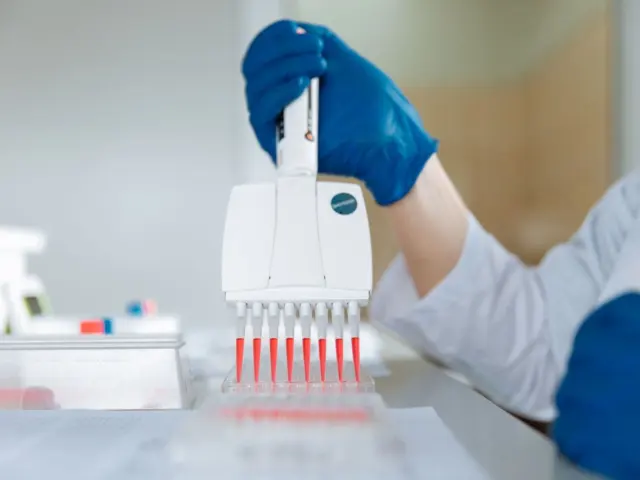

Wondering what biotech jobs actually involve day to day? Most sit in labs, manufacturing suites, quality teams or clinical trial oversight, and each asks for a different mix of skills and degrees.
This guide sits within our wider look at biotech careers.
| Item | Value |
|---|---|
| Median pay, quality control associate (2022) | $38,580 |
| Basic education for a clinical research associate | Life sciences or medical sciences bachelor’s degree |
| Typical in-person monitoring visit rhythm | Every 4-8 weeks |
| Share of CRAs on industry-initiated registration trials | More than 70% |
Figures come from Purdue’s quality control associate page and ICON’s clinical research associate guide. They can change, so check the sources before you rely on them.
How biotech jobs are grouped
It helps to think of the industry as a pipeline. An idea is researched, tested, made at scale, checked for quality and trialled in people.
Each stage has its own roles. Here are the main families you will see in job listings:
- Research and development: lab scientists and research associates who design and run experiments.
- Manufacturing and process work: technicians and engineers who grow, purify and produce a product.
- Quality: analysts and specialists who test products and keep records in order.
- Clinical research: staff who run and monitor trials in people.
- Regulatory and business roles: people who prepare submissions, manage projects or support sales.
Titles vary a lot between employers, so read the duties in a posting rather than the title alone. If you want the broader picture beyond biotech, our guide to life science careers covers neighbouring fields.
Lab and research roles
Research roles are what most people picture first. A research associate or scientist plans experiments, runs them, records results and reports what the data shows.
Entry-level lab posts often suit people with a bachelor’s degree and some bench experience from coursework or internships. Senior scientist and group leader posts more often ask for a doctorate, though requirements differ by employer and by the science involved.
Day to day, expect a mix of hands-on lab work, data analysis and meetings. Good note-keeping matters because other people must be able to repeat your work.
Manufacturing and quality jobs
Once a product works in the lab, someone has to make it reliably. Manufacturing roles cover running equipment, following written procedures and recording every step.
Quality work is split into two related areas. According to the University of Montana’s biotechnology centre, quality control analysts “perform laboratory testing to ensure that biotechnology and pharmaceutical products meet established quality and safety standards.”
Quality assurance looks at the system rather than the sample. The same source says responsibilities often include “reviewing documentation, auditing processes, overseeing deviations and corrective actions.”
Manufacturing quality specialists work closer to the production floor. They monitor operations, review batch records, investigate deviations and support corrective actions, per the same University of Montana page.
What a QC associate does
Purdue describes QC associates as people who work in quality control laboratories and biomanufacturing environments, using complex instrumentation to run tests. The work includes gathering and assessing test data and writing reports.
Paperwork is a big part of the job. Purdue notes that strict Food and Drug Administration regulations must be followed and documented at every step, and QC associates are responsible for that documentation.
Purdue cites a 2022 median salary of $38,580 for the role, based on Bureau of Labor Statistics data. Treat that as a rough guide for one job family, since pay varies by region, employer and experience.

Clinical research jobs
Clinical research roles suit people who like science but prefer coordination, documentation and travel to bench work. The best-known post is the clinical research associate, or CRA.
ICON describes a CRA as “a vital link between study sponsors and clinical trial sites.” CRAs monitor trials so that documentation, reporting and conduct follow the protocol and regulatory requirements.
Core tasks listed by ICON include:
- Conducting site visits and performing data verification.
- Managing study supplies and drug accountability.
- Preparing accurate monitoring reports.
- Facilitating site audits and resolving findings.
ICON says traditional field work involves site visits every 4-8 weeks, while more trials now use remote monitoring. It also says more than 70% of CRAs work on industry-initiated registration trials.
On entry, ICON states that a life sciences or medical sciences bachelor’s degree is the basic requirement to become a CRA.
Skills that carry across biotech jobs
Several useful habits carry across biotech roles, alongside role-specific technical skills.
- Careful record keeping: in regulated work, required steps must be documented so they can be verified.
- Following procedures: written methods help improve consistency across people performing the same task.
- Basic data skills: reading a chart, spotting an odd result and asking why.
- Clear communication: explaining a problem to colleagues who work in a different function.
- Willingness to learn instruments and software: tools change, and employers often train on their own systems.
You can build many of these before your first job. University lab courses, short technical certificates and internships all give you something concrete to describe in an interview.
Roles around the science
Not every post involves a pipette. Biotech companies also need people who plan projects, prepare paperwork for regulators, manage suppliers and explain products to customers.
Project and programme managers keep teams on schedule and track budgets. Regulatory affairs staff help assemble the documents that regulators review. Data and bioinformatics roles analyse large datasets, often with programming.
These roles still reward a science background because you must understand what the product does. They can suit you if you like the field but would rather work at a desk than at a bench.
Entry points for newcomers
Entry-level posts are usually titled technician, associate, assistant or coordinator. The word “associate” appears in both research and quality listings, so check the duties.
Read each description for the testing methods, the regulated environment and the documentation expected. That tells you more about the daily work than the title does.
Choosing a role that fits you
Start with how you like to spend a working day. If you enjoy detail and routine, quality and manufacturing may suit you. If you prefer open-ended problems, look at research.
Ask yourself a few practical questions:
- Do you want hands-on lab work, desk work or a mix?
- Are you comfortable with strict documentation rules?
- Would regular travel appeal or wear you down?
- Does the degree level asked for match what you hold today?
If you are coming from another field, our page on biotech career change explains how people move across. Quality and clinical roles are often discussed as practical entry points because they value careful, documented work.
Frequently asked questions
What are the most common biotech jobs?
Show answer
Common families include research, manufacturing, quality control and assurance, clinical research and regulatory work.
Do biotech jobs need a degree?
Show answer
It depends on the role. ICON gives a life sciences or medical sciences bachelor’s degree as the basic requirement for a CRA, and research leadership posts often ask for more. Check each listing.
Is quality control a good way into the industry?
Show answer
It can be. QC associates run tests and write documentation in labs and manufacturing sites, per Purdue. Purdue cites a 2022 median salary of $38,580 for QC associates; this is not an entry-level pay figure.
Can I work remotely in biotech?
Show answer
Lab and manufacturing posts need you on site. Some clinical monitoring is done remotely, since ICON says more trials now use remote monitoring, though site visits still happen.