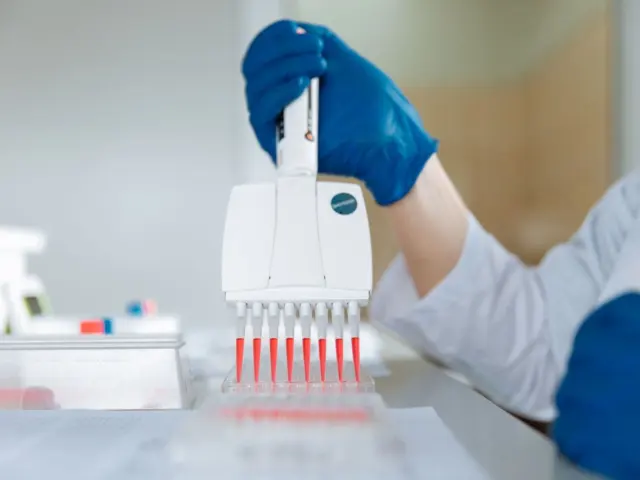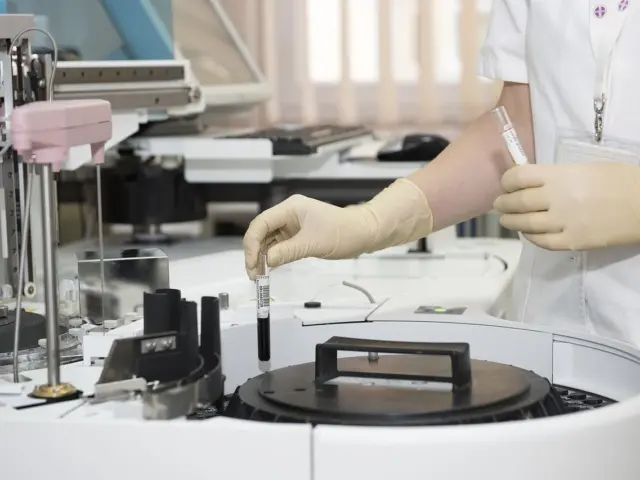

Wondering what a research associate really does all day? Mostly bench work: running experiments, recording data, keeping equipment and supplies in order, and reporting results to the scientists who lead the project.
| Item | Value |
|---|---|
| Closest O*NET occupation used here | Biological Technicians (19-4021.00) |
| Median annual wage, 2025 | $57,510 |
| Median hourly wage, 2025 | $27.65 |
| Workers reporting constant contact with others | 94% |
| Workers reporting face-to-face discussions every day | 83% |
These figures come from O*NET OnLine’s Biological Technicians summary, which was marked as updated in 2026. Titles and pay differ by employer, so check the source before you rely on the numbers.
This guide is independent and educational. It is not affiliated with any employer or agency named, and it does not offer recruiting or career services. It is one part of our wider look at biotech careers.
What does a research associate do?
“Research associate” is a job title, not a single standardised occupation. Universities, hospitals, biotech start-ups and large drug makers all use it, and the work changes with the employer and the seniority level.
The closest government occupation profile is the biological technician. O*NET describes these workers as people who set up, operate, and maintain laboratory instruments and equipment, monitor experiments, collect data and samples, make observations, and calculate and record results. Treat that as a proxy for a bench-level research associate, not a formal definition of the title.
At more senior levels, the title often means more independence. You may design experiments, supervise junior staff or contribute to papers, but those duties vary a lot between postings.
A typical day at the bench
Most days follow a rhythm set by the experiments running that week. The pattern below is a composite based on the O*NET task descriptions, not a schedule from any one lab.
- Check the plan. Review the protocol, confirm which samples or reagents are needed, and see what results arrived overnight.
- Prepare. Set up instruments, prepare solutions and samples, and make sure work areas are clean and supplied.
- Run the experiment. Follow the protocol, monitor the work and make observations as it proceeds.
- Record everything. Write down conditions, steps and raw results while they are fresh.
- Analyse and report. Process the data, check it against expectations and summarise it for the person leading the project.
Some of these steps are slow and repetitive. Doing them carefully is an important skill for newer staff.
Core tasks you can expect
O*NET lists detailed work activities for the biological technician occupation. Several of them describe the daily reality of a bench role well.
- Instrument work: set up, adjust, calibrate, clean, maintain and troubleshoot laboratory and field equipment.
- Sample handling: isolate, identify and prepare specimens for examination.
- Monitoring: monitor and observe experiments, recording production and test data for evaluation by research personnel.
- Data entry: input data into databases.
- Quality and compliance: monitor laboratory work to ensure compliance with set standards.
- Housekeeping: clean, maintain and prepare supplies and work areas.
- Reporting: analyse experimental data and interpret results to write reports and summaries of findings.
Depending on the field, some people may also analyse organic substances, such as blood, food and drugs.

Working with people, not just samples
Lab work is less solitary than many newcomers expect. In O*NET’s work-context data for biological technicians, 94% of respondents answered “Constant contact with others.” In the same data, 83% reported face-to-face discussions with individuals and within teams every day.
O*NET also lists communicating with supervisors, peers or subordinates as a work activity. That can happen by telephone, in writing, by e-mail or in person.
In practice, that means short meetings with the principal investigator or team lead, handovers with colleagues who share instruments, and questions to core facility staff. Clear written notes help everyone, including the person who reads them months later.
Pay and how the role can grow
O*NET reports a 2025 median wage of $27.65 hourly, or $57,510 annually, for biological technicians. Actual research associate pay depends on location, sector, degree and level, so use this as a rough anchor and compare real postings.
O*NET also notes that its Job Zone examples for this kind of occupation often involve coordinating, supervising, managing or training others. Some roles may offer opportunities to take on more planning, training and project responsibility.
If you are early in your search, our guide to entry level biotech jobs shows how this role compares with other starting points. For a wider view of related paths, see our overview of life science careers.
Skills that make the daily work easier
Technical skill matters, but habits matter just as much. A careful record-keeping habit is what separates a reliable associate from a hurried one, because an experiment you cannot reconstruct is hard to trust.
Employers tend to value the following, and you can build most of them in a student lab or a short placement:
- Following written protocols exactly, and flagging when something deviates.
- Comfort with core techniques named in the posting, such as pipetting, cell culture or sample preparation.
- Basic data handling, including spreadsheets and, increasingly, simple scripting.
- Clear, brief written updates that a busy colleague can act on.
- Safe habits: protective equipment, labelled materials and tidy benches.
None of these requires a senior title. Showing them in a short project or a lab course often counts for more than a long list of buzzwords.
How to judge a posting before you apply
Because the title is so loose, read the duties list rather than the headline. A few questions help you tell what a role really involves.
- Is the work mostly running set protocols, or designing experiments?
- Will you manage the lab, order supplies or train others?
- Does the role involve writing papers, grants or regulated documentation?
- Which instruments and techniques are named, and have you used them?
Matching your hands-on experience to the named techniques usually matters more than the exact title.
It also helps to ask in an interview what a normal week looks like, how much of it is bench time versus desk time, and who reviews your work. Honest answers tell you whether the role will build the skills you want next.
Frequently asked questions
Is a research associate the same as a lab technician?
Show answer
Not always. The titles overlap, and O*NET’s biological technician profile is the nearest government match, but a research associate role can include more planning and analysis, depending on the employer.
Do research associates work alone?
Show answer
Rarely. O*NET’s work-context data for biological technicians shows 94% reporting constant contact with others and 83% reporting daily face-to-face discussions.
What does a research associate earn?
Show answer
O*NET lists a median of $57,510 annually for biological technicians, the closest profile, in its 2025 wage data. Pay for a specific research associate job can be higher or lower.
What tasks are most common?
Show answer
Setting up and maintaining instruments, preparing specimens, monitoring experiments, entering data into databases and writing up results are all listed in O*NET’s task data.