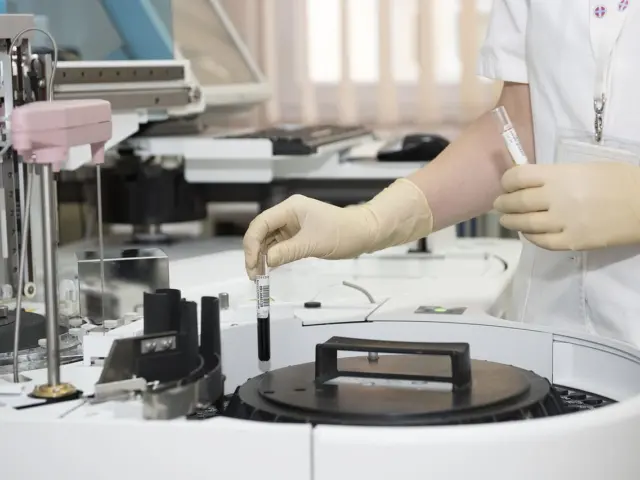
Wondering how a lab idea becomes a medicine on a pharmacy shelf? The drug development process runs from discovery through animal studies, human trials and regulatory review, and the whole journey often takes 10-15 years.
This guide is part of our look at the biotech industry, and it shows where different jobs fit along the way.
| Item | Value |
|---|---|
| Typical time from discovery to patient | 10-15 years |
| Phase I participants | 20-100 volunteers |
| Phase II participants | Up to several hundred people |
| Phase III participants | 300-3,000 people |
| FDA review window for the first IND submission | 30 days |
Figures come from University of Cincinnati Online and Biotility at the University of Florida. They can change, so check the sources before you rely on them.
The drug development process at a glance
Developing a medicine is a sequence of gates. Development generally proceeds in stages, but clinical phases can overlap.
Each gate is built around a question. Is the compound doing something useful? Is it safe enough to try in people? Does it work, and do the benefits outweigh the risks? Only then does a regulator decide whether it can be marketed.
The path usually runs through these stages:
- Discovery and early development in the lab.
- Preclinical research in test tubes and animals.
- Clinical research in people, in phases.
- Regulatory review by an agency such as the FDA.
- Safety monitoring once patients are using the product.
Most candidates never finish. That is why the process is slow, expensive and full of roles for scientists, clinicians, regulatory specialists and manufacturing staff.
The timeline is the part people find hardest to believe. The University of Cincinnati says each stage can take years and needs many scientists, pharmacologists and lab assistants, and it puts the whole journey at 10-15 years on average.
Think of the stages as a relay rather than a single race. A discovery chemist may never meet the clinical team that tests the drug years later, yet each handoff depends on the quality of the data passed along.
Discovery and preclinical research
Discovery starts with many tests of molecular compounds to find possible beneficial effects against disease, according to Biotility. Teams then assess candidates for absorption, dosage, side effects and interactions with other drugs, as the University of Cincinnati describes it.
Preclinical work comes next. Before testing a drug in people, researchers must find out whether it could cause serious harm, also called toxicity. These studies use laboratory and animal testing to answer basic safety questions.
Preclinical work also raises practical questions, such as how the drug will be administered. The University of Cincinnati notes that once the research meets FDA standards for data quality, integrity and reliability, the drug can move on to the clinical research phase.
That emphasis on data quality is worth remembering if you are choosing a career. Careful, well-documented lab work is what makes later stages possible.
Nonclinical safety studies supporting FDA applications must follow applicable good laboratory practice rules; basic exploratory studies are excluded. These set minimum requirements for study conduct, personnel, facilities, equipment, written protocols and quality oversight.
Preclinical results are not the end of the safety question. The FDA’s own wording, quoted by the University of Cincinnati, is that preclinical research “is not a substitute for studies of ways the drug will interact with the human body.”
The IND application: permission to test in people
After preclinical testing, researchers review their findings and decide whether the drug should go into people. If it should, the developer files an Investigational New Drug (IND) application before any clinical research begins.
The FDA review team has 30 days to review the original IND submission. Afterward, the developer must keep the team informed about new protocols and serious side effects seen during the trial.
For a career-minded reader, this is where regulatory affairs, toxicology and clinical operations teams start to work closely together.
The IND package pulls together what the preclinical studies found and how the first human study will be designed. Developers think about what they want to accomplish in each clinical phase while they design the study, so planning and paperwork overlap heavily at this point.
A weak preclinical record or an unclear study plan can slow the whole programme. Regulatory writers and project managers work to make sure the package is complete before it is sent.
Clinical research: what happens in each phase
Clinical research tests whether a drug is safe and effective in humans. The FDA divides it into four phases, and the University of Cincinnati gives rough participant numbers and the share of drugs that move on. Our guide to clinical trial phases covers the detail.
- Phase I: 20-100 healthy volunteers or people with the condition, with about 70% of drugs moving on.
- Phase II: up to several hundred people with the condition, with about 33% moving on.
- Phase III: 300-3,000 people with the condition, with about 25-30% moving on.
- Phase IV: post-approval work that follows the drug in the general population.
The pass rates are approximate figures from one university source, so read them as a rough guide to attrition rather than a precise statistic.
Notice how the participant counts grow from one phase to the next. A small early study is simpler to run, while a late-stage study needs a large operations team.
It also explains why late-stage trials are so costly to run.
Each phase asks a different question. Early studies look at safety and dosing, middle studies at whether the drug seems to work, and late studies confirm benefit and risk in a larger group.
Regulatory review and life after approval
Before a company can market a new drug in the United States, it must obtain FDA marketing approval; Phase IV studies occur after approval. According to the University of Cincinnati, that submission is either a New Drug Application (NDA) or a Biologics License Application (BLA).
The process does not end at approval. The FDA has several programs that continue to monitor a drug’s safety and efficacy while it interacts with the general population.
That ongoing monitoring is why safety, pharmacovigilance and medical affairs roles continue long after launch.
Who does the work: biotech, pharma and your career
Large and small companies both take part in this process, but they often differ in how much of it they own. If you are comparing employers, our article on biotech vs pharma explains how they differ.
A small biotech might own discovery and early trials, then partner for later phases. Large firms often run late-stage trials, manufacturing and global launch.
For job seekers, the useful takeaway is that every stage creates different work:
- Discovery: research scientists and assay developers.
- Preclinical: toxicologists and pharmacologists.
- Clinical: trial managers, data managers and clinical scientists.
- Review and monitoring: regulatory affairs, quality and safety staff.
Frequently asked questions
How long does the drug development process take?
Show answer
The University of Cincinnati puts the average from discovery to patient at 10-15 years. Individual drugs vary widely.
What is an IND?
Show answer
An Investigational New Drug application is the filing developers must go through before clinical research begins. Biotility says the original submission gets a short review window before human testing can start.
What is the difference between an NDA and a BLA?
Show answer
Both are formal submissions to the FDA for marketing approval. The University of Cincinnati lists them together as the two routes, with the application type depending on the product.
Why do so many drug candidates fail?
Show answer
Candidates can fail on safety or on effectiveness at any gate. The University of Cincinnati’s approximate figures show only a fraction of drugs moving on from each clinical phase.
Does safety monitoring stop after approval?
Show answer
No. According to the University of Cincinnati, the FDA has several programs that continue to monitor a drug’s safety and efficacy in the general population.